

The light changes first. Mornings arrive a little later, evenings come a little sooner, and many of us notice our mood shifting with the season. That shift is a good reminder of how closely gut health and mental health are linked.
Autumn asks the body to recalibrate. Our sleep, appetite, energy and focus all adjust to shorter days, and for some of us that adjustment brings a familiar heaviness: lower motivation, more restless nights, a harder time concentrating, a little more worry humming in the background.
With World Mental Health Day on October 10, this feels like the right moment to talk about something we see every day in our coaching work. Mental health doesn’t only live in the mind. Instead, it lives in the body too, and one of the most important places it shows up is the gut. That’s why this post looks at the link between gut health and mental health, plus simple ways to support both this fall.
Autumn, the Large Intestine and Letting Go
In traditional Chinese medicine, autumn belongs to the Metal element, which is paired with two organs: the lungs and the large intestine. Its emotion is grief, and its work is letting go. In other words, autumn is about releasing what we no longer need so we can take in what nourishes us.
I grew up around these ideas in Hong Kong, long before I understood the science behind them. Now, however, what strikes me is how this ancient framework echoes modern research. In TCM, autumn is tied to the large intestine and to emotional release. Meanwhile, the colon is home to most of the trillions of microbes in your body (Sender et al., 2016), and that community is at the center of some of the most exciting work in mental health today.
The Link Between Gut Health and Mental Health
Your gut and your brain are in constant conversation. Scientists call this the gut-brain axis, and it runs in both directions. Here’s how the two talk to each other:
- GUT-BRAIN AXIS. Your gut and your brain are in constant conversation. Scientists call this the gut-brain axis, and it runs in both directions. Here’s how the two talk to each other:
- THE VAGUS NERVE. This long nerve runs from the brainstem to the abdomen, carrying signals both ways. A large share of its traffic travels up from the gut to the brain, which is one reason a stressed gut can leave you feeling anxious, and an anxious mind can upset your stomach (Breit et al., 2018).
- MESSENGER MOLECULES. The great majority of the body’s serotonin is made in the gut, and gut bacteria help regulate how much is produced (Yano et al., 2015). Gut serotonin doesn’t travel directly to the brain, but it shapes digestion and sends signals along the nerves that do. Certain gut bacteria also produce or influence GABA and dopamine, chemical messengers involved in calm, focus and motivation (Cryan et al., 2019).
- INFLAMMATION. When the gut lining is irritated or the microbiome is out of balance, inflammatory signals can circulate through the body and reach the brain. Low-grade inflammation has been linked in research to depression and low mood (Miller & Raison, 2016).
- SHORT-CHAIN FATTY ACIDS. When your gut bacteria ferment fiber, they produce compounds like butyrate that help maintain the gut lining and calm inflammation (Cryan et al., 2019).
- THE STRESS RESPONSE. Chronic stress changes the makeup of the microbiome, and the microbiome in turn helps regulate how strongly we react to stress (Cryan et al., 2019).
What the Research Says About Gut Health and Mental Health
The research is still young, but it’s growing fast. A 2019 study published in Nature Microbiology looked at the gut bacteria of more than 1,000 people in Belgium and found that two groups of bacteria, Coprococcus and Dialister, were consistently lower in people with depression, even after accounting for use of antidepressants. And in the 2017 SMILES trial, published in BMC Medicine, adults with moderate to severe depression who shifted toward a Mediterranean-style diet — more vegetables, legumes, whole grains, fish and olive oil — saw significantly greater improvement in their symptoms over 12 weeks than those who received social support alone. By the end of the study, about a third of the diet group met the criteria for remission.
Of course, none of this means mental health struggles are “all in your gut.” Instead, it means the gut is part of the picture, and one we can do something about every single day.
How Gut Health Affects Mental Health: ADHD, Anxiety and Depression
The people we work with often arrive having already done serious work on their mental health. For example, many have been in therapy, and some take medication that genuinely helps. Even so, something still feels stuck: the 3pm crash, the brain fog, the anxiety that spikes after skipped meals, or the sleep that never quite restores them.
That’s often where the body comes in.
- Anxiety can be amplified by blood sugar swings, caffeine, poor sleep and a nervous system that rarely gets the signal it’s safe to rest.
- Low mood and depression are linked with inflammation, nutrient gaps and disrupted daily rhythms — all areas where small, steady changes add up.
- ADHD brains are especially sensitive to the basics: protein, steady blood sugar, sleep and movement. Researchers are also studying how gut bacteria may differ in people with ADHD (Gkougka et al., 2022). It’s early science, but the daily foundations already make a real difference to focus and emotional regulation.

We’ve lived a version of this ourselves. A while back, I gave up caffeine for a long stretch, and the biggest change I noticed wasn’t my energy. It was my anxiety. I hadn’t realized how much of that jittery, on-edge feeling was coming from my cup rather than my circumstances. I drink coffee again these days, but that break taught me to notice how it affects me, and when it’s helping versus when it’s just adding to the noise. Working on my own gut health has taught me the same lesson again and again: the body and the mind are never really separate conversations.sson again and again: the body and the mind are never really separate conversations.
A Fall Guide to Gut Health and Mental Health
You don’t need a cleanse or a complicated protocol. Instead, you need a few consistent habits that work with the season. Here’s where we suggest starting.
1. Eat the Season — and Eat for Variety
Your microbes thrive on diversity. Research from the American Gut Project found that people who ate 30 or more different plants a week had more diverse microbiomes than those who ate 10 or fewer. Herbs, spices, nuts, seeds, beans and grains all count.
Fall makes this easy, and many of the seeds we love count too. Reach for:
- Apples and pears, rich in pectin, a fiber your gut bacteria love
- Squash, pumpkin and sweet potatoes for fiber and beta-carotene
- Leeks, onions and garlic, natural prebiotics that feed beneficial bacteria
- Mushrooms like shiitake and maitake
- Lentils, chickpeas and beans for fiber and steady energy
- Walnuts and pumpkin seeds for omega-3s, zinc and magnesium
2. Add Something Fermented Every Day
A 2021 Stanford study published in Cell found that eating more fermented foods over ten weeks increased microbiome diversity and lowered markers of inflammation. Start small, with a spoonful or two a day:
- Plain yogurt or kefir
- Kimchi or sauerkraut (look for the refrigerated, unpasteurized kind)
- Miso stirred into warm (not boiling) soup
- A splash of kombucha in place of soda
3. Start the Day with Protein
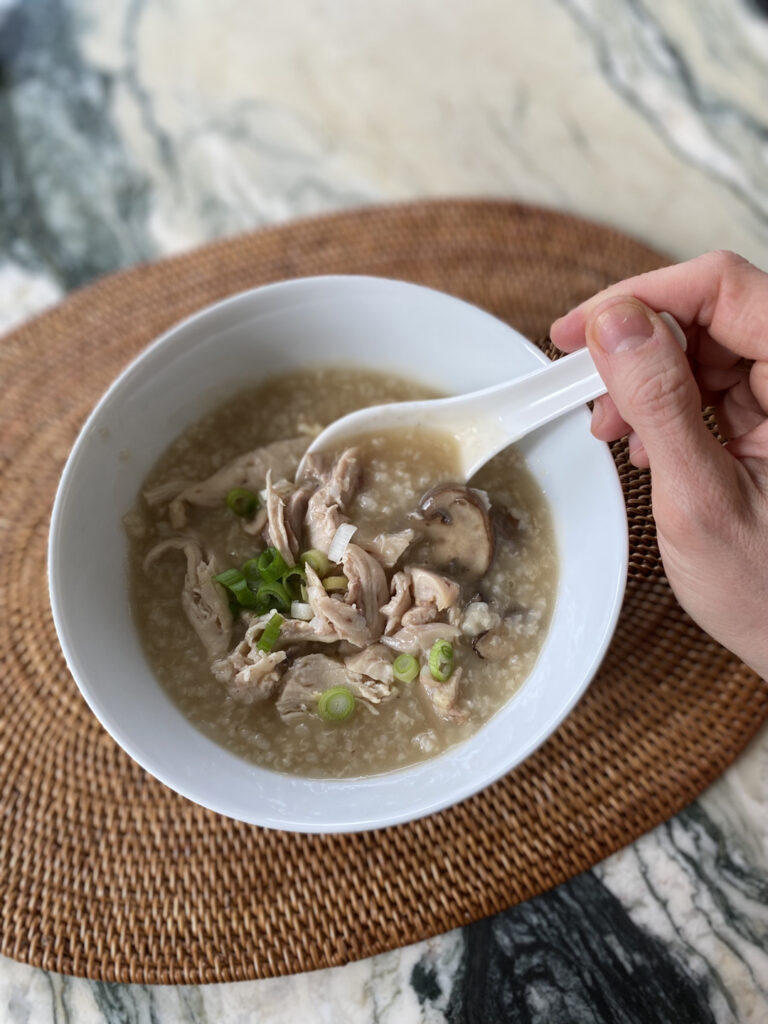
A breakfast built on protein and fiber keeps blood sugar steadier through the morning. Ideally, aim for roughly 20–30 grams of protein at breakfast, such as three eggs, a cup of Greek yogurt with seeds, or a savory bowl of congee with chicken and an egg. For many of our clients with ADHD and anxiety in particular, this one shift brings noticeably calmer, more focused mornings.
4. Get Morning Light
Shorter days nudge our internal clock off course. As a result, sleep, mood and digestion can all shift. That’s why we suggest spending 10–20 minutes outside within an hour of waking, even when it’s cloudy. Outdoor light is many times brighter than indoor light, so it helps set your rhythm for the whole day. If you’re really stuck indoors, we recommend a light like this Verilux Happy Light to help you get through those long dark days.
5. Give Your Nervous System a Signal to Rest
Digestion works best when the body feels safe. Before meals, or whenever anxiety rises, try a few rounds of slow breathing with a longer exhale: in for four, out for six. Research on slow breathing shows it shifts the nervous system toward rest-and-digest and raises heart rate variability, a marker of vagus nerve activity (Zaccaro et al., 2018).
6. Notice Your Stimulants
We all know by now that caffeine and alcohol both affect sleep, blood sugar and anxiety. You don’t have to give them up entirely, but just notice your timing and habits. Just get curious: how do you feel the afternoon after your second coffee, or the morning after a glass of wine?
7. Get Curious About Your Own Gut
Every microbiome is different. With some clients, we use Tiny Health gut microbiome testing to see what’s actually happening inside — which bacteria are thriving, which beneficials are missing, and where inflammation may be showing up. It turns guesswork into a data-supported plan.
As always, please check with your doctor before starting new supplements, especially if you’re taking medication for your mental health.

Mind and Body, Together: Our Work with The Pond
We believe mental health care works best when the mind and body are cared for side by side. That’s why we’re proud to partner with The Pond Psychology Practice in New York.
Founded by Dr. Vanessa Li in 2020, The Pond offers therapy done differently — combining evidence-based approaches like cognitive-behavioral and psychodynamic therapy with art, music and movement-based therapies, in both individual and group settings.
Our role is complementary. Therapy creates space to understand your thoughts, emotions and patterns. Meanwhile, coaching helps you build the daily habits that support your body through that work, including what you eat, how you sleep, how you move, how you manage stress and how your gut is functioning. Through our coaching services, we support Pond clients and others navigating:
- ADHD
- Anxiety
- Depression and low mood
- Burnout and chronic stress
- Sleep struggles
- Major transitions, including motherhood and midlife
Coaching doesn’t replace therapy, medication or medical care. It works alongside them, helping you turn what you’re learning in therapy into everyday habits that support how you feel.

Supporting Gut Health and Mental Health This Season
Autumn is a season of release. Just as spring is a natural time for supporting your liver, autumn invites us to slow down, look honestly at what we’re carrying, and make room for what helps us feel well. Caring for your mental health this season might look like therapy. However, it might also look like a bowl of warm soup, a morning walk, a spoonful of kimchi and an earlier bedtime.
Small things. Done often. Together, they add up.
As you move into the colder months, take a moment to ask yourself:
- How does my body feel when my mood dips?
- What’s one thing I could add to my plate this week, rather than take away?
- What would it feel like to have support for both my mind and my body?
Support Through Seasonal Transitions
If you’re working on your mental health and sense your body has been left out of the conversation, this is exactly the kind of work we do at Wildseed. Together, we look at your nutrition, sleep, stress, rhythms and gut health. Then we build simple, sustainable practices that support your gut health and mental health, so you can think and feel your best.
If this resonates, you’re welcome to book a complimentary clarity call to explore whether coaching could be a helpful next step for you.
If you’re in crisis or having thoughts of harming yourself, please reach out for immediate support. In the US, you can call or text 988 to reach the Suicide & Crisis Lifeline.
Be well, stay wild! 🌿
References
- Breit, S. et al. (2018). Vagus nerve as modulator of the brain–gut axis in psychiatric and inflammatory disorders. Frontiers in Psychiatry, 9, 44.
- Cryan, J. F. et al. (2019). The microbiota-gut-brain axis. Physiological Reviews, 99(4), 1877–2013.
- Gkougka, D. et al. (2022). Gut microbiome and attention deficit/hyperactivity disorder: a systematic review. Pediatric Research.
- Jacka, F. N. et al. (2017). A randomised controlled trial of dietary improvement for adults with major depression (the ‘SMILES’ trial). BMC Medicine, 15, 23.
- McDonald, D. et al. (2018). American Gut: an open platform for citizen science microbiome research. mSystems, 3(3), e00031-18.
- Miller, A. H. & Raison, C. L. (2016). The role of inflammation in depression: from evolutionary imperative to modern treatment target. Nature Reviews Immunology, 16(1), 22–34.
- Valles-Colomer, M. et al. (2019). The neuroactive potential of the human gut microbiota in quality of life and depression. Nature Microbiology, 4, 623–632.
- Wastyk, H. C. et al. (2021). Gut-microbiota-targeted diets modulate human immune status. Cell, 184(16), 4137–4153.
- Yano, J. M. et al. (2015). Indigenous bacteria from the gut microbiota regulate host serotonin biosynthesis. Cell, 161(2), 264–276.
- Zaccaro, A. et al. (2018). How breath-control can change your life: a systematic review on psycho-physiological correlates of slow breathing. Frontiers in Human Neuroscience, 12, 353.




+ show Comments
- Hide Comments
Add a comment